Why Mine the Asteroid Belt?
I had never honestly considered this question before until I read the article "A Billion Tons of Nickel" by Chad Orzel (In case you were wondering his article was inspired by a previous article of mine: A Floating City on Venus). The author brings up a good point: What advantage would mining the asteroid belt really have? After reading his article I honestly could not come up with a reason off the top of my head. I had just assumed it would be a great thing that one would jump at the opportunity to take advantage of.
He made an excellent point questioning the economic viability of such a mining operation:
Absent some project that requires vast quantities of whatever you can mine out of the rock, the main effect of this would seem to be a global crash in the price of whatever you can mine out of the rock. At which point, I don't know how your recoup your investment. This is barely Economics 101-- if you have a billion tons of nickel sitting around, and nothing to do with it, the price will be very low. We've done the experiment, after all-- ask the Spanish about all that New World gold...Frustrated that I could not find a good answer quickly enough I decided to a little research and here is what I came up with:
He's absolutely correct. Though the article is missing the true incentive to asteroid mining. The key to asteroids are that they have a relatively high proportion of precious metals such as platinum and those in the platinum group. On top of that they also contain many other metals in high demand such as aluminum, copper, and titanium among many others. Here is a chart of the approximate composition of a C-type (Carbonaceous) asteroid (including potential values per metric ton in dollars). According to the chart platinum contains roughly 1,000 parts per billion in a typical C-type asteroid. This equates to about 2,000 metric tons in a one kilometer diameter asteroid or approximately $50 billion worth of platinum. Albeit the price of the metal would drop as more metal is introduced into the market but nowhere near the catastrophic affect that Chad proposes with the mining of nickel. This is simply because platinum is in very high demand and an exorbitant amount isn't being introduced. The other metals I mention could also conceivably be very profitable though likely not to the same extent.
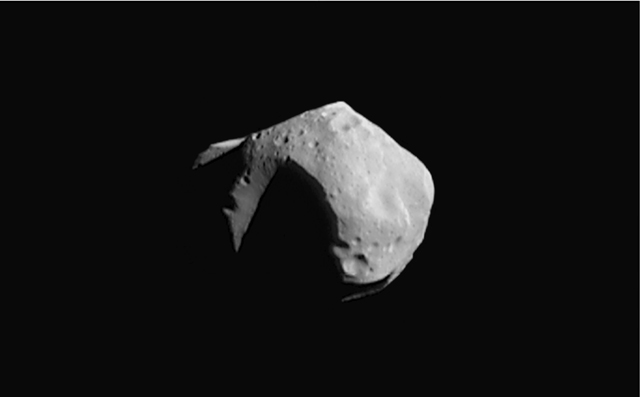
Image of C-type asteroid 253 Mathilde. Source: NASA.gov
Now the situation he describes with the introduction of Aztec gold is a bit different than platinum. During that time gold was primarily sought after for its beauty and luster alone. Platinum on the other hand is used in jewelery and industry--especially in electronics. This should further resist a collapse in the metal's economy and perhaps increase the economy overall. Even a drastic price drop in platinum wouldn't be so bad. One can simply look at the history of aluminum. Aluminum used to be worth more in weight than gold. Then in 1886 a young engineer from Oberlin, Ohio named Charles Martin Hall invented a new method of extracting aluminum that eventually made it cheaper to obtain by a factor of 200. Clearly the economy wasn't ruined by an over-abundance of aluminum. This is because aluminum was rare in pure form but had many potential uses. The case is very similar for platinum.
At the end of his article he also left us with this:
(And circular arguments like "We need a billion tons of nickel to build space ships to mine the asteroids/ colonize the moons of Jupiter/ fly to Alpha Centauri" are cheating.)And though the space enthusiast in me really wanted to justify mining the asteroids with this I knew he was correct; we have to be realistic and know how the world works. I believe I've addressed the incentive to mine the asteroids without using this cheating circular argument though. Thus since we have created a market for going to the asteroid belt we can now fairly use this argument! Because with the advent of mining operations we will indeed create a whole new 'space market.' Sending materials up into space is costly (currently around $12 million per metric ton). This means that billion tons of nickel now has a new purpose--building those spaceships to mine the asteroids. So, while gleaning materials to build ships that can mine the asteroid belt or to build colonies is not the initial reason to mine the asteroid belt it is a natural progression and soon does become an incentive in itself.
For more information on the potential of mining asteroids I suggest reading through these two sites:
Asteroid Mining for Profit (chart came from this site)
and
PERMANENT
Also, if anyone has any counter-arguments or questions I would definitely like to hear them. I tried to stick to the main points to maintain the brevity of this post so I'm sure there is still much to discuss if anyone is interested.
Related Articles:
 Category:
Asteroid Belt Mining,
Space Economics
Category:
Asteroid Belt Mining,
Space Economics


16 comments:
LOL.
I think you need to think differently about how you valuate the materials.
A price for minerals refined here on earth is fine if you plan to bring everything back. In the future, when there is demand in space, you would have to add the cost of lifting the materials into orbit to your calculations. When the time comes for mankind to be looking to get out of the solar system, asteroids are likely to not only be sources of raw materials, but I'd bet someone is going to figure out how to hitch a ride on a pile of mass with a significant store of kinetic energy.
The Aztec gold thing is really a red herring. Few materials are useless to a modern culture. If you were sitting on a huge pile of nickel-iron, be sure someone would find a use for it. Plus, it's generally more profitable to sell cheaply in bulk. Compare Rolls-Royce and Ford.
I left the following comment on his blog:
If you're the one providing the billion tons, you still make plenty of money.
After a while you won't be the only provider, but the existence of competing mining operations in the asteroid belt implies a substantial space-bound economy. With a growing industrial economy, there will be more demand.
Your example about New World gold is instructive...I think it's safe to say that the colonization of the New World was an enormous boost to the global economy, even though the extractive industry that started it wasn't sustainable at the initial level.
Also, recent research into "peak metals" suggests that earthbound sources are going to get a lot more pricey:
http://baloghblog.blogspot.com/2006/01/now-what-peak-metal.html
Humans have spent the past hundred thousand years expanding to use more resources. At no point did the prices of resources collapse sufficiently to make the expansion end. Once we can mine the asteroids at reasonable cost, we'll do it, and the expansion will continue just as it has since the dawn of our species.
Post 1: I'm afraid I don't know what you mean by valuating the materials differently. Anyways, I would think that the cost of sending equipment into orbit would be a massive investment but primarily a one time deal. Once the mining infrastructure is established then shipping raw materials back to Earth would be a relatively trivial cost compared to the capital earned from selling the commodities. I definitely agree with you about asteroids not being the only source but the seem to have a high proportion of the very expensive platinum metals.
By the way, hitching a ride on an asteroid is an awesome idea. I don't believe I've ever heard of that before but it makes perfect sense. It's like catching a ride on our solar system's version of a ferry.
Julian- Not only is it a red herring but even if it were true the person who mines the asteroids first can easily control the supply. It would be something of a nickel cartel I suppose :).
Post 3- Thanks for the link and I like your other arguments. I have heard a lot about peak oil but not so much about peak metal. Perhaps as it becomes more necessary we will expand into new horizons (i.e. space) but hopefully our curiosity and natural human urge to explore will start the process much sooner.
There are a couple problems with economic calculations that determine the value of a commodity where it is NOT needed. This one also ignores the "premium" people are willing to bet/pay to back thier belief that man is destined to expand into the cosmos. If we ever get off this rock, we will owe it to people with vision, not nay-saying bean counters. This study also don't account for the environmental advantages of moving the center of the mining economy to a place where you dont have to tear up a planet to get access to materials, they just drift by....
If I am travelling around our solar system (or out of it), why would I be interested in the price of a pound of platinum on the surface of a planet almost to the bottom of a gravity well? I certainly WOULDN"T be looking at mercury / venus / earth / mars for raw materials. I'd be looking for materials as far away from the sun as I could find.
In time it will be "logical" for folk to understand that visitors to our corner of the galaxy will probably be WAY more interested in sliding through the "atmosphere" of our gas giants to collect reactives and propellants, with a short dip down to the "precious metals" suppliers hanging out just "outside" the orbits of thier raw materials.
It is incredibly sad to see the miniscule amount this great country is spending to maintain its productive presence in space.
I guess the politicians will remain ignorant until they see a hollywood movie about materials recovery robots dropped on an approaching meteor/asteroid. I'll have to remind the robot designers to include "special-effect like" explosions in thier design so the "mass-conversion" efforts are exciting enough to entertain the masses of humans we have saved from extinction.
Post 4 (Anonymous)- I whole heartedly share your sentiment on the lack of funding towards space exploration in this country (and the globe in general). You're also right about it being the visionaries who take us to outer-space. It will be the visionaries who take the risk on whether reaching the asteroid belt and mining it will become cost-effective in time or not. They will understand that we are destined to expand to space and profit will come eventually. Those 'bean counters' however, will not want to take the risk of investment and will always go for the quick buck.
Hopefully, someday, the politicians will be pressured into passing legislation pro-space colonization because as we all know, for the most part, they are more concerned with money and winning the next election than actually doing the best thing.
Just came across this discussion, most interesting. I suspect we are still far away from a decision based on return on investment. Has anyone done the cost modelling in detail?
But what I want to add is this: the fundamental decision is political not economic and not scientific. The nation that mines the asteroid belt, that places a base on the moon rules the world. You who recall "The Moon is a Harsh Mistress" know you can easily throw rocks from the moon to the earth.
I have wondered if the US refusal to pursue lunar occupation might not in part have come from a worry that war might result to prevent the US from occupying the ultimate high ground.
In my view the effort will have to be multi-national to gaurantee a non-military application. Let me put it this way, if the present Chinese government were about to colonize the moon I would consider it a strategic threat to the security of the West.
No doubt The Chinese would think the same if the US was seriously proposing lunar colonization.
Post 7: That is an interesting slant on things. I'm willing to bet there is a good deal of validity to that.
You say the fundamental decision is political and not economic, but if you think about it, the political decision stems from people wanting power. Power is usually achieved through wealth and so my belief is that yes, it will be a political decision, but that decision will be a derivative of an economic decision.
Then again, this is a general trend of humanity as a whole. Who knows, perhaps some renegade will see this vision through with different motivations.
I think we are missing the closest analogy in history to situation we are facing here. That was the 1607 & 1620 colonization "missions" to Jamestown & Plymouth Rock. Did they wait for British government to finance those ventures? (if they had they'd probably still be waiting!). I'm sure they had these same pessimist "bean counters" argueing that the ventures were not "cost effective" etc. People have an adventurous spirit & will go if we can just convince them that it is feasible.
If we could get a few million people to sign-on & finance project instead of a government bureaucracy (like NASA). Whether we build 1st 10,000 population colony inside an asteroid as proposed in 1964 book "Islands in Space" or completely structured as later proposed by O'Neill & Heppenheimer can be left to a vote by people who sign-on to venture. Sound possible? See my 5 steps to speed up realization of this starting at: http://technocrat.net/d/2006/2/20/757
Nature finds a way to deal with a surplus. While the Spanish Gold from the New World did depress contemporary gold values, the Julian Morrison is exactly right about modern culture's ability to deal with a glut of material.
Modern examples of adding value to a commodity and reselling it aren't hard to find and have been a huge asset to our economy. Cut off from their supply of nitrates toward the end of WWI, Germany developed a way to easily synthesize the material, necessary for making bombs. This technology was used around the world during WWII, and when it ended suddenly, bomb makers were left with huge quantities of the stuff. They decided to sell it as a cheap and highly effective fertilizer. This caused a spike in food production, without which our planet may well not have been able to support our current population growth.
The fertilizer also allowed for huge amounts of corn. Changes in U.S. farming policies added subsidies that encouraged adding ever more corn to the market no matter what it did to corn prices. This ended up being bad for farmers but produced so much corn it became a commodity that was open to have value added to it in a huge variety of ways. It's the primary food of most of our meat, it's the main ingredient in all our tasty beverages, it can be made into plastic and alcohol, and etc.
So I do not at all understand the point of view that there is no money to be made in a glut of something as infinitely useful as iron. Obviously billions of tons of nickel would depress nickel prices and have an effect on associated industries, so I can certainly see why some executives and investors would do all they can to prevent such a thing as asteroid mining. But the amount of money that could be made should make up for this economic hiccup, so I still see it as an inevitability as long as there is enough investment capital and entrepreneurial foresight to get past the initial risks.
I've always felt (inspired no doubt by the writings of Ben Bova) that mining the asteroid belt would provide resources to Earth that we are currently mining here, and causing environmental damage in the process. The reason to "import" these materials is so that we don't choke on our own fumes digging it out of the ground ourselves.
The article seems to suggest that the only valuable things in asteroids are precious metals that have little or no practical value. Is that really true? Is there nothing available in the Belt that it would be better to go and get rather than obtain locally?
If asteroid crash then will be end of the world...
I'm surprised no one has suggested asteroid mining as a way to cut the costs of further missions. Send a mission to Mars and you don't get much out of the venture beyond knowledge. Send a mission to Ceres and bring back an asteroid, is ore expensive, but you still get knowledge and the asteroid helps cover costs. Since its big you could just send it very slowly inward so as to get near the dark side of the Moon, limiting risk. Then send it down or use it there. It could take years, but it could at least start to covers its cost.
I would just like to say that not only would we get minerals and materials from the asteroid belt, but we would also gain a lot of knowledge when we go there. This would make the cost more worth it, because it is also scientific exploration. This would make us also boost our technology, something we have needed to do for years, by building robots. Of course, the thought of leaving the planet Earth because of lack of minerals is pretty far away. That's why we should start planning now so we don't become frantic when we are mineral defficient. We don't only have to use the asteroid belt, though. Planets that are currently untouched are incredibly rich in almost everything we need. The only problem is that, for instance, Venus is way too hot of a climate for "astro-miners" to be in for any period of time. There isn't really a way to combat that. I think that we currently need to focus on making a plan, not necessarily executing it yet.
There's plenty of dust and materials in the Solar System, each ship as it does age will acquire plenty of this material because of gravity. Those initial examples of cost-effective mining of an Asteroid Belt will be part of parts reuse from spacecraft. The initial trapping of some asteroids could be the side-effect of self-sealing ship-hulls. That intentional mining will require a large material infrastructure to be in place which does transfer it into the distant future.
I will add this blog to my favorites, it is great.
Post a Comment