Sunday, February 25, 2007

Bigelow Interviewed by MSNBC--Lunar Habitat in the Works!

It is a little late right now but here is a link to the awesome interview. Look for comments and analysis from me soon! In the meantime feel free to ask any questions about the article or mention anything that you feel should be addressed in my commentary.

Related Articles:

Wednesday, February 21, 2007

The Top 10 Things to Experience in A Space Hotel

A lot of excitement and talk has been about since the advent of Robert Bigelow's plans for launching hotels into space--and for good reason. An opportunity to stay overnight in space orbiting around the Earth and experiencing micro-gravity is definitely reason enough to be excited. What a lot of people don't know though is what you can do with this kind of setup. That is why I have decided to write this fun list:

The Top 10 Things to Experience in A Space Hotel

View from the Hubble Telescope. SpaceTelescope.org
# 10. Viewing the Northern & Southern Skies with hotel observatories.

With no light pollution and no atmosphere to interfere the view would be amazing. Stars would lose their distinctive "twinkle" without the atmosphere but different colors would become apparent. Those amazing images provided by Hubble could now be accessed by guests at any time.

# 9. Views of the Moon.

Simply put, a new perspective of that object in the sky that has been a fixture for eons. Again, without an atmosphere the view would be much clearer and telescopes would allow for very close views. Maps of the Moon could also be made available and you could point out different craters and and cracks.

# 8. Star... err... Earth Gazing.
Spectacular view of the Aurora Australis. Courtesy NASA.gov
Sitting in a space hotel that is at an altitude of approximately two to three hundred miles the Earth would almost entirely fill your view. Many of the fortunate few that have viewed the Earth from orbit have said it is impossible to be unaffected by the site. Other than being able to spot landmarks and geographical features there are many amazing things to see--even on the dark side of the Earth. Lightning flashes roughly 100 times a second and the aurorae (another awesome image taken from the ISS) near the magnetic poles dance brightly across as colorful rippling cones of light. Other amazing views include watching dusk and dawn outline the edges of the Earth with multicolored bands of light and the formation of different weather patterns.

# 7. Checking In.


Check in is a whole new experience in itself. You start by unbuckling yourself from your seat and gathering your luggage. After picking up your belongings you simply Velcro them to your body and float through the corridor! Guided by a railing you make your way towards the main entrance, gradually increasing in gravity until you can walk normally. The artificial gravity is produced by the slow rotations of the hotel container.

# 6. Checking Out.
Sunrise in orbit. Courtesy ESA.int
Checkout is more than the sad departure from this dream holiday; it has its own amazing experience attached too. After boarding the departing spacecraft you feel the sudden jerk of the ship separating from the docking bay and then the momentary surge of the thrusters as it moves away from the s
hip and towards the Earth for reentry. As you come back hurtling towards Earth at faster and faster speeds you start to see the air glow as it flies past the windows. Then the sky starts to change from a black into a dark blue until you hit the upper atmosphere. The sky is now a magnificent blue color. The sound of rushing air penetrates the cabin as clouds come closer and closer. The excitement soon comes to a close and you make a routine landing at the spaceport just like a plane does at the airport.

# 5. Weight Watching.

A space station presents an unique opportunity for experiencing different strengths of gravity. With multiple containers on the space hotel variable spinning speeds can be done. Set your containers speed to virtually zero and you can experience the weightlessness that astronauts of today encounter or if you're wanting to feel more at home you can set the revolutions per minute (rpm's) of your cabin to the equivalent of one G. Experimenting in between could also be quite fun. Simply adjust the rpm's so that you experience a weight of 100 lbs or even 20 lbs. Or, if you're wanting to build a little more muscle, you could even increase the relative gravity.
(see the physics behind this concept)

# 4. The Trampoline Room.


Not much to describe here, the title pretty much sa
ys it all. Micro-gravity + trampolines on the floor and ceiling = endless possibilities.

# 3. Space-Sports.
A Zero-G Arena. Courtesy Space.com
Variable artificial gravity opens up a whole new dimension for sports--literally. Games can now be played in 3-dimensions. A large, open container could be the new playing field for 3D tag or 3D dodge ball. Just imagining the more Earthly games such as soccer, basketball, and football in micro-gravity can make your mind swirl with excitement. Now, take wrestling and picture it in micro-gravity. Then, picture it in G-forces stronger than what we experience now. Are you starting to get the picture of all the possibilities? These are just different versions of already made games. New games are sure to be created. Anyone's guess is as good as mine when it comes to speculating the future of space sports but, just to get the ball rolling, I'll throw out a few ideas...
Once hotels are established in space bigger, newer inflatable stadiums could be launched into orbit or even constructed in space. Try to picture giant, inflated spheres with seating all around and the playing field, for whatever game/sport, right in the middle. Tweaking the relative G-force of the playing field could let humans fly like birds on Earth too. Strap on carbon-fiber (or some other lightweight material) wings and little stabilizers on the end of your feet, begin flapping, and away you can fly! After some practice you could eventually master diving and completing barrel rolls.
New (or old) contact sports could become a lot fiercer and at the same time a lot safer. With
lowered gravity falling becomes less of a hazard. Couple that with padded walls all the way around and the risk for injury is almost gone! You could try all the stunts that you could ever imagine and remain almost worry free!

Here's a cool article from Space.com that gives an early look at space sports going on now in a modified Boeing 727-200 aircraft that takes you for a free fall. They also speculate on the future of space sports.


# 2. Sleeping Arrangements.


The room! The setup would be similar to any Earthly hotel but the experience would be far from it. First, you have your window. Take a look outside at the Earth and the rest of space or get a fantastic view of the rest of the space hotel. With the room spinning to maintain artificial gravity your view will also be constantly changing.
Asleep in Space. Source: NASA.gov
The artificial gravity presents an unique aspect in itself too. Low-gravity could allow for perhaps the most comfortable sleeping conditions conceivable. When resting on the mattress in only a fraction of normal gravity your body is less compressed. That means your spine will straighten out and your body can completely relax. Blood circulation would also be at a maximum so you wouldn't have to worry about arms or legs falling asleep. Don't worry about falling off either; Velcro sheets could fasten you in. Evidence has supported this claim of better sleep in space too. Space.com wrote:
During a study of two 1998 space flights, five astronauts stopped snoring almost completely. The astronauts also experienced a significant decrease in sleep-disturbing periods of breathing cessation, called sleep apnea, as well as periods of slow and shallow breathing called hypopnea. more...


Oh, and with news of the plan for the first first ever honeymoon in space, I'm sure couples could**ahem** try various 'rendezvousing and docking' methods in partial or zero gravity.

and......


# 1. Low-G Swimming
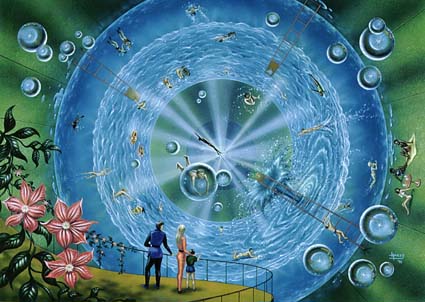
Artist's rendition of a spinning, low-g swimming pool. Courtesy SpaceFuture.com
Artificial gravity has yet another fantastic exploit--a swimming pool! Water's properties combined with variable gravity make for an amazing combination. If the giant container is spinning the water will adhere to the inner walls. Imagine jumping out of the water, completing some acrobatics, and then flying back into the water on the ceiling above you! Large enough containers can allow for very high diving boards too. The typical 'daredevil' could make Olympic divers look like amateurs. Splashing games amongst friends will also suddenly have a whole new meaning with the addition of low G-forces. Swimmers can pick up large armfuls of water and hurl them in a wobbly mess across the pool--tidal-waving their friends rather than merely "splashing" them.

Take the water to a zero-G room and a slew of new forms of entertainment arise. You could literally grab blobs of water and throw them like snowballs across the room and watch them explode into pieces as they hit the wall. Jumping inside larger blobs of water is now possible too. Swim around like a goldfish in a fishbowl or simply blow bubbles on the inside of your blob. Next you exit the blob and mold it into various shapes. Pull the water out in strings or transform your blob into a donut by blowing a large bubble in the center and bursting it. Or you could try spinning it and watch it take all sorts of shapes.

...

Hopefully this list has piqued your imagination or at least given you some new information on the capabilities of space. If anyone has any other ideas for possible experiences in a space hotel let me know by adding a comment and I will add a "Bonus Section" for submitted ideas! I will also be sure to list your name (and website if applicable) next to the idea! I'm looking forward to your ideas so please add them!

Lastly I want to thank (and recommend) the book Your Spaceflight Manual for providing me inspiration for this piece and for providing me great information.

Related Articles:

Sunday, February 11, 2007

Money Backing the Private Space Industry... Part 3--Robert Bigelow

Continued from part 1 and part 2...
Robert Bigelow has expressed his disappointment in the development of manned space exploration. Growing up captivated by the Apollo 11 moon landing Bigelow has said, "It's been 30 years since the last beginning and we don't have anything to show for it but memories. People are tired of memories." This time he is doing something about it. After acquiring his fortune through his Las Vegas hotel chain Budget Suites of America, he pledged to spend up to $500 million by 2015 to give manned space exploration a much needed boost.

Bigelow envisions a whole new breed of hotels: Space Hotels. He has plans of offering a 330-cubic-meter space station (about the size of a 3 bedroom house) for a paltry $1 million a night. Guests will fly around the Earth every 90 minutes traveling 17,500 miles/hour and absorb spectacular views of the Earth and the surrounding galaxy. Learning weightless acrobatics will also become a common pastime for guests.

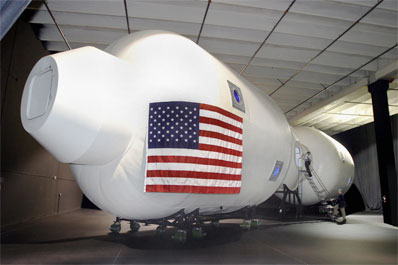
Already built, inflatable Nautilus modules.
These incredible ambitions are not from idle words either. His pledge to front $500 million for the project and the successful launch of Genesis I, the 1/3 scale model Transhab, have already been mentioned (see article) but what else has brought this project closer to reality than most would have ever thought possible? Well, for one, a deal has already been made between Bigelow Aerospace and Elon Musk's SpaceX to have the Falcon 9 launch an expandable space-station in the first quarter of 2008. A $50 million "America's Space Prize" has also been presented by Bigelow for the group who can create a spacecraft that can take 5 or more people to an altitude of 400 km, demonstrate the ability to dock with a Bigelow Aerospace inflatable space habitat, and repeat the trip within 60 days. The deadline is Jan. 10, 2010. The real prize though, is the potential $200 million purchase agreement for six flights of a selected vehicle. This can be awarded to a company after the deadline if it is preferred over the winner's design. In addition to the $200 million deal there is another $800 million available in options contracts for 24 flights over a span of about 4 to 4.5 years!

Like Jeff Bezos (see part 1), Bigelow displays sincere ambitions too. His life's dream is very similar to mine (see site purpose). He was only 15 years old when he vowed to devote his life to establishing a permanent human presence in space. Already aware of the difficulties it would take he knew he would need money--lots of it. Soon after his vow, he aggressively began laying the foundation for accumulating his wealth. He followed in his father's footsteps by studying real estate and banking at Arizona State University. Upon graduation, he immediately put his real estate education into practice by buying small rental properties. Three years later, in 1970, he constructed his first apartment house, a 40-unit building. For the next two decades he continued expanding by building dozens of apartment buildings and motels in the Las Vegas area. In 1988 he founded his lucrative Budget Suites of America.

Concept design of a completed space hotel.
All throughout this time, Bigelow kept space in the back of his head and only in the back of his head. The motivation for his ambitious expansion of his company was kept entirely secret. I didn’t even tell my wife,” he says. “She never knew. Because it’s possible that that kind of dream would never happen.” Serendipity struck in 1999 when Bigelow stumbled upon a NASA project for a radical new space station concept. The radical concept was called the Transhab project. In 2000 NASA canceled it for no apparent reason and so Bigelow bought the exclusive development rights. Bigelow believes he can accomplish what NASA couldn't because of his business expertise. "I’ve put together many, many projects involving a lot of money and a lot of people,” he says, and unlike NASA, “I’m used to doing things pretty darn well on budget and pretty darn well on time.

Thus ends my 3 part series on the money behind the dream. I hope you learned something new about the private space industry or perhaps became inspired yourself to join the industry!

To read more about the Transhab technology NASA provides a great article that covers the basics.

Related Articles:


Monday, February 5, 2007

Money Backing the Private Space Industry... Part 2

Continued from part 1...
This next group of backers may not qualify for the billionaire category but they have been huge patrons of the private space industry. Jim Benson started the trend of tech entrepreneurs moving into the commercial space market in 1997 with the founding of SpaceDev. SpaceDev provided the unique hybrid rocket motors used on the now famous SpaceShipOne. Benson recently stepped down as CEO/CTO of SpaceDev and announced his intentions of creating a new space venture appropriately named Benson Space Company. Named one of the "50 People to Watch in 2005" by San Diego magazine it is difficult to disagree.

One of the most influential figures has been Anousheh Ansari. Making her fortune through a Telecom company, Anousheh is most famous for helping fund the Ansari X-prize. The $10 million X-prize can be largely accredited for the jump start of the commercial space race. It lead to Burt Rutan's SpaceShipOne, backed by Paul Allen and winner of the X-prive, deal with Richard Branson and the founding of Virgin Galactic.

The prize has also pushed other non-winning companies such as John Carmack's Armadillo Aerospace. Most famous for his co-founding of id Software and for making games such as Doom and Quake, Carmack recently taught himself rocket engineering and is the lead engineer of his company. Armadillo Aerospace has ambitious plans of building orbital spacecrafts.

Elon Musk, another internet mogul other than Jeff Bezos, has also shown some serious interest in space. Using his fortune (estimated at $328 million) earned from his creation of PayPal, Musk founded Space Exploration Technologies (SpaceX). SpaceX currently has one rocket, the Falcon 1, that was launched unsuccessfully this year but is scheduled for a relaunch this month. Elon has said he is willing to fund up to three unsuccessful launches before he decides to scrap the company. With success of upcoming launches there looks to be a lot of promise. SpaceX has already sold 11 contracts for flights on the various Falcon rockets. The company was recently awarded the Indefinite Delivery/Indefinite Quantity (IDIQ) contract for Responsive Small Spacelift (RSS) launch services from the US Air Force that could be worth up to $100 million worth of launches.

Space Adventures founder Eric Anderson has taken unique steps to gleaning his wealth and power in the commercial space industry. He is unique because he has been the only one to start his entrepreneurial ventures in the actual private space industry and his company has thus far been the only company in the world to have sent private citizens to space. Joining several visionaries in the aerospace industry, Anderson's company has sold more than $120M in space tourist flights.

He has also currently developed and financed over $500 million in new projects, including a deal with the Ansari family's company, Prodea, and the Russian space agency (FSA) to develop a suborbital space transportation system called Explorer, a project for two global spaceports and another one for the first private voyage to the moon, set to launch in 2009. The Explorer will be able to transport up to five people to space and is designed to maximize the customer's experience of space travel. The two commercial spaceports have been announced for development in the United Arab Emirates and in Singapore. Most exciting, however, is the project for the first private voyage to the moon. The project is titled the Deep Space Expedition Alpha (DSE-Alpha) and has plans for sending tourists on a trip around the moon. Space Adventures has partnered with the FSA to use modified Soyuz capsules for the trip. Seats for the trip come at a hefty price though. Two commercial seats are available for an incredible $100 million. But, with another customer of theirs, Dennis Tito, paying $20 million for a trip to the ISS, a $100 million ticket price for a trip around the dark side of the moon might be the right price for a wealthy enthusiast.

The last figure in my series of money backers is Robert Bigelow. Bigelow is at the forefront of the private space industry and looks so promising that all the information about him cannot fit in this article alone. Continue coming back and looking for an updated article exclusively about his contributions to commercial space, including a deal for a launch with Elon Musk and SpaceX.

And... as always, feel free to comment on or ask about anything you please! I feed off of your input and always look forward to it. Thanks for everyone's contributions so far!

Related Articles:

Sunday, January 21, 2007

Money Backing the Private Space Industry... Part 1

While conversing with someone the other day I realized how little the common person knows about the private space industry. Sure, people have heard about Dennis Tito and Lance Bass paying an exorbitant amount of money to travel into space or even Virgin Galactic, Richard Branson's suborbital space tourism company. Beyond that, however, not much else is known. So, what kind of funding is behind this industry? Let's take an in-depth look:

Three billionaires alone are placing big bets on the future of space industry including the 6th richest man in the world: Paul Allen. Allen, who, according to Forbes, is worth more than $22 billion and admits to spending "in excess of $20 million" on SpaceShipOne, said he wouldn't be the sole investor in any space venture — although he might be willing to go in with someone else. Richard Branson, another multi-billionaire and founder of Virgin, hasn't specified the amount he is willing to spend but already has contracts in the works for a Virgin labeled SpaceShipTwo. Virgin Galactic plans to fly 500 passengers a year at about $200,000 each, to an altitude of slightly over 100 km.

Jeff Bezos, the 147th most affluent person in the world with a net worth of $4.3 billion and founder of Amazon.com, looks like a very promising backer. So far his company, Blue Origin, has been relatively quiet and has hardly made a rustle in the news but the company looks very serious. Blue Origin seems to be the biggest sleeper in my opinion and Jeff Bezos looks to be perhaps the most exciting prospect for the future of space. A source close to the Blue Origin group has said that the company has an ambitious 20 year plan:

They want to develop near-Earth space, not only from a tourism standpoint They see industry up there: space colonies, hotels, stuff like that. They want everything, not just ballistic trajectories.
Normally, this kind of talk would be considered an afterthought but when you realize the kind of money Bezos has and the kind of funding his money could bring with him things start to get interesting. Beyond the secrecy and the money behind the idea there is an interesting piece of Bezos' past that seems to solidify the seriousness and potential of this company:
In 1982, the high school valedictorian told The Miami Herald that he hoped to one day put space hotels, amusement parks, and yachts in orbit. Bezos biographer Robert Spector thinks his life goal is to "amass enough of a personal fortune to build his own space station." (courtesy wired.com)
Not only has Bezos accumulated a lot of money early (he is only 42), his net worth is still growing— and growing quickly. His net worth has almost tripled since 2003 (was worth $1.7 billion).

Even though Blue Origin is very secretive and has been more of a "think-tank" for most of its history it has produced some tangible progress. The New Shepard spacecraft has already undergone some initial test launches. The craft will eventually provide flights up to an altitude of 100km. To further substantiate Blue Origin's progressive attitude and genuine goals one need only look at their qualifications for employment:
"We are building real hardware, not PowerPoint presentations," said a job notice posted on the Blue Origin Web site in April, 2003. "You must have a genuine passion for space. Without passion, you will find what we're trying to do too difficult.

"There are much easier jobs."

Other than members of the billionaire club there are several other mega-rich people worth mentioning. Come back for part 2 to read more about them and the private space industry as a whole. As always questions and requests are invited. Be looking for part 2 soon!

Related Articles:

Monday, January 15, 2007

Space Elevators: A Future I can Envision.. Part 2

A Space Elevator (see original post...) seems pretty glamorous and looks to have lots of potential, but what exactly is that potential? A Space Elevator could provide a safe, consistent, and cheaper method of bringing cargo to space. This is the key to its limitless potential. With space easily accessible, permanent settlements could be established and always have supplies on demand. Expanding out towards the asteroid belt could also mean the start of outer-space mining operations. Gigantic solar satellites could also send enormous amounts of energy back to Earth and other satellites could increase communication abilities on earth.

Concept art of a space elevator. Source: CelestialMotherlode
One potential use or derivative of a space elevator that I thought of but haven't heard anything about is a construction site. Things can be manufactured in space with less difficulty than they can on Earth. Micro-gravity lets very heavy objects to be reasonably maneuvered. Enormous cargo ships could be put together quickly and easily. Such ships couldn't even feasibly be made on Earth and sent to space. The micro-gravity presents another interesting advantage too. Designs of such ships would not need to be able to hold themselves up. Without any gravity putting pressure on it, designs wouldn't need to be as sturdy and without an atmosphere aerodynamics is useless. Now, a fleet of huge cargo ships could be quickly and cheaply put together. Distributing materials also becomes even more efficient than with the space elevator alone. Since the cargo ships need not escape a planets atmosphere it will never require large amounts of fuel to transport goods. All it would need is one boost towards its destination and one back. Materials/people could be carried by these cargo ships/shuttles and simply be "dropped off at the door." Re-entry vehicles released by the cargo ships could release goods in similar fashion to the current Mars rovers' method. As you can see a space elevator could be the catalyst for an interplanetary highway.


The economics of a space elevator is also interesting. Currently the price/kg to send something into geosynchronous orbit is about $20,000/kg. According to Dr. Bradley Edwards, who has put forth a space elevator design, the price would drastically reduce to around $220/kg.

Costs of Edwards design (mentioned in part 1) has been estimated at $40 billion. In order for the design to be privately funded a $6 billion annual revenue would be needed and 2 million kg/year would be lifted into space. A cheaper estimate for another design was proposed at the 55th International Astronautical Congress in Vancouver in October 2004. The sticker price was a mere $6.2 billion. $6.2 billion may still sound extraordinary but when comparing that to the costs of bridges, skyscrapers, and other large projects it starts to look a lot more enticing.

Personally, I believe that the space elevator concept is pretty far-fetched but, then again, so was walking on the moon at one time. I can't say the space elevator will lead humans into a space-colonization age but I can say that it is a very worthy idea to consider.

Related Articles:

Saturday, December 23, 2006

Space Elevators: A Future I can Envision.. Part 1

Concept art of a space elevator. Source: Lift Port Group
(see part 2) So, what exactly is a space elevator? It's exactly what you'd imagine; an elevator that goes into space. Basically the ideas proposed for a space elevator consists of a "base station" that has a geosynchronous counterweight tethered to it.

The four basic elements required for such a concept are: the base station (as previously mentioned), a cable sometimes referred to as the "ribbon", climbers (the elevator portion), and the counterweight.

The base station could come in a variety of forms. One being a mobile form. The base would most likely be positioned in the ocean or another large body of water. Its mobility could be used to maneuver away from satellites and other orbiting objects but I think something as amazing
Concept art of a potential Base Station. Source: Lift Port Group
and "game-changing" as a space elevator would take precedence. It would be much simpler to change the orbits of everything else and use the cost/material advantageous method of a stationary base. A stationary base could theoretically have a significantly shorter, required cable length depending on altitude. A shorter cable could also reduce the required thickness of the cable as a whole, eliminating even more cost and materials necessary.

The technology for cable construction is not as far away as one might think. It is estimated that the tensile strength required for the tether would have to be in the range of 65-120 Gigapascals. To put it into perspective steel has a mere 2 GPa or less of tensile strength. Fortunately, the advent of carbon nanotubes has produced strands that could resist as high as 52 GPa before snapping and the theoretical capability is beyond 120 GPa. Mass production and creating large strands is currently an issue but the future looks optimistic as the demand for carbon nanotubes is way beyond just space elevators. We're talking computers, planes, bridges, rockets, and other materials in general. Demand is high and likewise research too.

Concept design of a Climber. Source: Lift Port Group
Climbers would serve as the "elevator" of the system but due to a construction requiring a larger center than tips ( necessary because of centripetal forces) it would not use typical elevator methods. Hence, the name climbers. The proposed designs, friction held rollers and robotic arms with hooks, present less of a challenge than actually powering the climbers. The best method I've read about so far has been powering it by lasers. The concept would be similar to a laser powered solar sail (look for a post about this in the upcoming future). This technology is still in its infancy and isn't very efficient currently but it looks very promising.

Lastly, we have the counterweight. Many have pushed the idea of an asteroid as a counterweight but I happen to like the potential of the alternative: a space station. Not a whole lot to explain here and I'm sure you could imagine some of the capabilities a space station on top of a space elevator could have. I.E. spaceport, research labs, weightless space construction, space hotels, etc. etc.

Lifting the cable into space presents a bit of a problem but Bradley C. Edwards (former Director of Research for the Institute for Scientific Research) has proposed a highly efficient method for doing so. The method involves creating an initial, "seed" cable that is very thin and launching it first. Next, small climbers would progressively add thicker and thicker cables from the ground up until the desired proportions are reached.

Initial costs are also relatively "affordable" for a system similar to the seed cable, starting at an estimated $5 billion.

My next post will concern the advantages and the costs that a space elevator would have in more, specific depth. I invite you all to come back and read it and to also post any questions or comments that you would like to see addressed in the next article.

Related Articles:

Friday, December 22, 2006

Water Currently Flowing on Mars?!

"December 06, 2006
WASHINGTON - NASA photographs have revealed bright new deposits seen in two gullies on Mars that suggest water carried sediment through them sometime during the past seven years.
"These observations give the strongest evidence to date that water still flows occasionally on the surface of Mars," said Dr. Michael Meyer, lead scientist for NASA's Mars Exploration Program continue reading..."

Before and after imagees depicting erosion. Source: NASA.gov

With liquid water this means there is an even greater possibility for life on Mars than previously thought. Other than potential life on Mars (and something the article fails to mention) is the potential of the situation.With liquid water underground the proposition of a permanent outpost doesn't seem so far fetched. The water could be used for fuel, energy, and obviously a water supply for humans. If there wasn't a reason to visit Mars with humans there certainly is one now.

This is also an interesting addition of knowledge concerning the possibility of terraforming parts of Mars or even all of it. There is already a tented city thats is going to be finished within the next year or two on Earth in Kazakhstan. Thats right, the same country that the character Borat is from... Now imagine for a moment, the 58th highest GDP country in the world with $125 billion in purchasing power [ref] ; what could a nation with $12.3 trillion [ref] accomplish? Building a tented outpost or colony on Mars doesn't seem that far fetched now. Imagine if another Paul Allen or Richard Branson (Virgin Galactic) decided to invest a better portion of their net worth into a similar tented outpost.

Projected images of the completed city of Astana. Source: BBC News
Take for example Robert Bigelow (previous post), he has spent a scant $75 million to research, develop, test, and launch Genesis I into orbit and it took him a mere 6 years to get to this point from absolutely nothing. Now look at NASA on the other hand... it has cost them over $100 billion since 1993 to get to the point where they are now with the ISS [ref]. And while Bigelow is prepared to spend a mere $500 million through 2015 to complete several space hotels and sell them for $100 million a piece NASA is estimating costs $300-500 billion. Keep in mind that this is only NASA's contribution to the ISS and doesn't include the 14 other countries involved. So, with the efficiency of private
companies a mission to Mars or even an establishment on Mars doesn't seem too far-fetched, especially with the recent interest from wealthy individuals.

Related Articles:

Tuesday, December 19, 2006

Genesis I Completes Successful Launch into Space

Inside Genesis I after successful inflation in space. Source: Bigelow Aerospace

The first huge step was completed in the Genesis project by Bigelow Aerospace. On July 12, 2006 the Genesis I module was launched on a Dnepr booster from the Yasny Launch Base in Siberia. According to the Bigelow Aerospace website (see page) the 1/3 scale model completed all its assigned tasks.


The exclusive article from Space.com reports,

"Thanks to a boost today from a Russian and Ukrainian rocket-for-hire company, a U.S. private space firm has sent a novel expandable module toward Earth orbit—and a step forward in providing commercial space habitats.

Bigelow Aerospace of North Las Vegas, Nevada is flying prototype hardware that the firm anticipates will advance habitable structures in space to carry out research and manufacturing, among other tasks. continue reading..."


Outside Genesis I after successful inflation in space. Source: Bigelow Aerospace


Genesis II has a launch date set for January 30, 2007 and looks to be on schedule. The Genesis II will run similar tests but will also allow non-employees to pay for small objects to be sent aboard the module for $295. Not too bad of a price to be able to brag that you sent a picture of yourself into space. I mean how many people can say they have a photo of themselves in space?

Anyways, the Genesis project is the precursor to the Nautilus space station module-- a 45 ft. X 22ft. inflatable SPACE HOTEL. It was initially a design concept by NASA that was inevitably trashed. That's where Robert Bigelow comes along and purchases the TransHab technology from them. Bigelow plans to produce several of the Nautilus Transhabs with a cool asking price of $100 million.


Related Articles:

My Purpose

Welcome to my Space Monitor blog. I hope you will find this blog to be fascinating, thought-provoking, informative, and inspiring.

Let me outline some goals I have for this site. Any feedback would be appreciated so if you have an opinion, comment away!
Anyways, here is what I had in mind:

1. Since the site is spacemonitor.blogspot.com, I obviously have a plan of monitoring space! But, to be a bit more specific, I plan on updating this blog whenever any big announcements come from the space travel/tourism/colonization area. Basically, I will be keeping tabs on all the major private companies involved in the privatized space industry such as Bigelow Aerospace, Virgin Galactic, Armadillo Aerospace, SpaceDev, Blue Origin and many more.

Besides commercial companies, I will also update on relevant news from government agencies (NASA, ESA, Russian Federal Space Agency, Chinese Space Agency, etc).

2. Not only do I want to make the blog a "one-stop" portal for space travel/tourism/colonization news I also want to add my own "two-cents" to the article. I want to comment on all aspects of news such as feasibility, the technology involved, possible ramifications, alternatives, spin-offs, etc.
But I don't want it to be all me. I want to make it interactive and hear your opinions, thoughts, and ideas. If demand is ever large enough I would definitely like to set up a community related to the blog for everyone to participate in (experts and neophytes alike).

3. I have a dream of one day starting my own space travel/tourism/colonization company and so I would like to occasionally post my own ideas and progress. I am currently in the very, very beginning stages of initiating my dream but if you stick around long enough I'd like to share with you my progress and my methods for achieving my goals. This topic will probably be the least updated but I will try to incorporate it into my comments on other space articles.

4. Occasionally I will write miscellaneous posts that don't really fit into any of the above categories. This will happen whenever inspiration strikes so I can't really put a specific label on this. Just know I will try to make it worthwhile :).

I will try to update this as much as possible, in the meantime I would appreciate any ideas or opinions.

-Pat

It has been a fun ride so far so I thought I'd give a list of some of my all time favorite posts... I appreciate everyone's feedback on my articles and I definitely enjoy the discussions.

Personal Favorite Posts:

And the a list of all the articles in order of popularity by viewers (as of 7/05/07):
  1. A Floating City on Venus
  2. Magnetic Launch System
  3. The Top 10 Things to Experience in A Space Hotel
  4. Why Mine the Asteroid Belt?
  5. Money Backing the Private Space Industry.. Part 3--Robert Bigelow
  6. Space Elevators: A Future I can Envision.. Part 1
  7. "Genesis I is About to Have Company"
  8. Space Elevators: A Future I can Envision.. Part 2
  9. Money Backing the Private Space Industry.. Part 1
  10. Money Backing the Private Space Industry.. Part 2
  11. New Player in the Game: European Aeronautic Defence and Space Company--Astrium
  12. About This Blog--My Purpose
  13. Copy of PDF file
  14. Absolutely Awesome Images of Space
  15. Lunar Dirt Factories? A look at how regolith could be the key to permanent outposts on the moon!
  16. Genesis I Completes Successful Launch into Space
  17. Water Currently Flowing on Mars?!
  18. Genesis II- Updates from Bigelow Aerospace
  19. The Space Colonization Series
  20. Colonizing Mercury
  21. The Manifest Destiny: Mark II
  22. Bigelow Interviewed by MSNBC--Lunar Habitat in the Works
  23. Recommended Space Blogs
  24. Great Space Quotes